Many RFPs are built to find the lowest unit price. Teams can spend the following year paying for that decision.
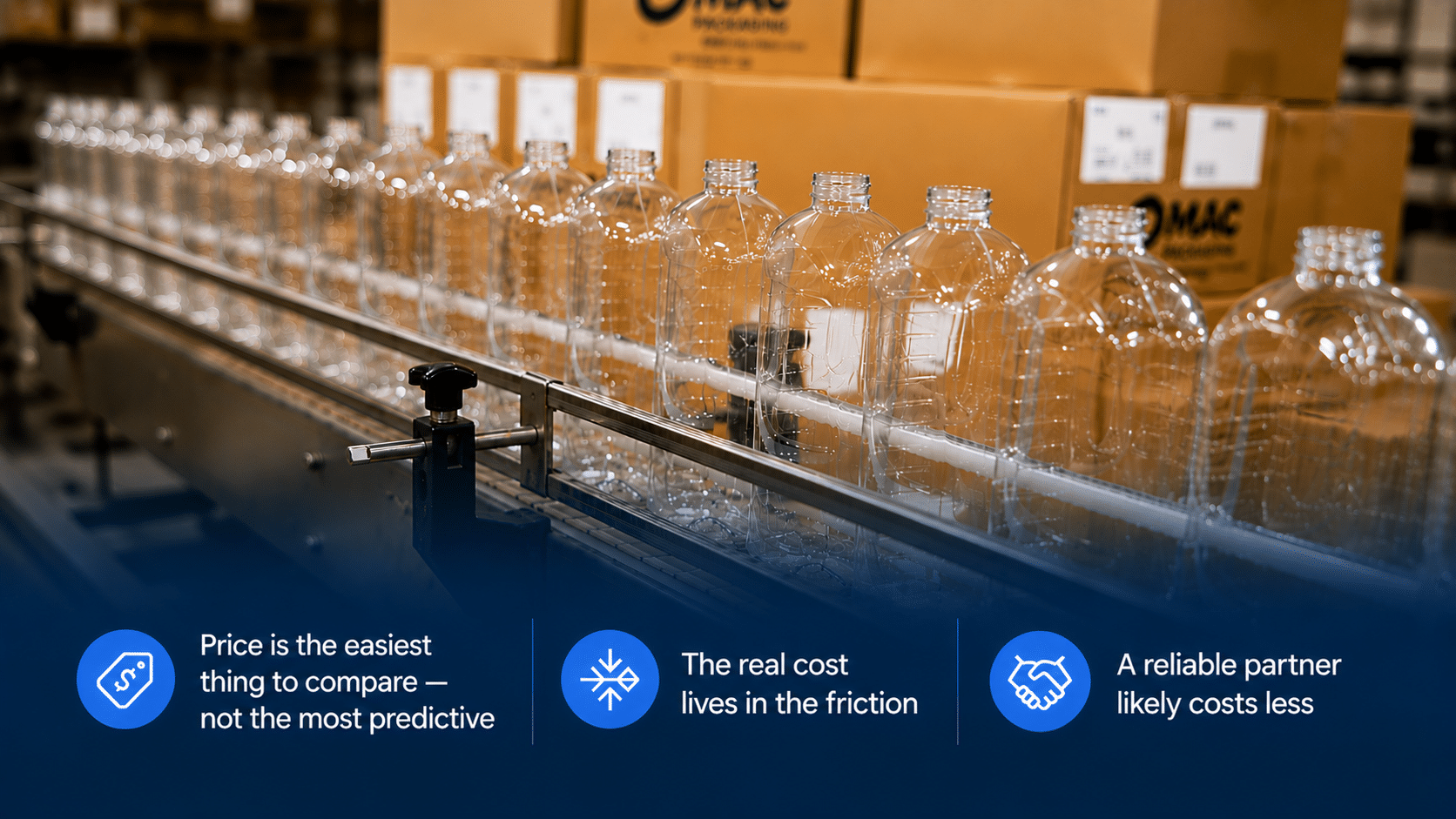
The RFP process for contract manufacturing is well-intentioned. You define your specifications, send them to a short list of partners, collect quotes, compare line items, and make a decision. It’s structured and feels rigorous. And it optimizes almost entirely for the one thing that’s easiest to compare: price.
What it may not be capturing is the thing that actually determines whether the relationship works: execution. How cleanly orders move through their systems. How quickly issues get communicated. How often timelines shift, and whether you hear about it before or after it affects your business. How much internal time your team spends just keeping things on track.
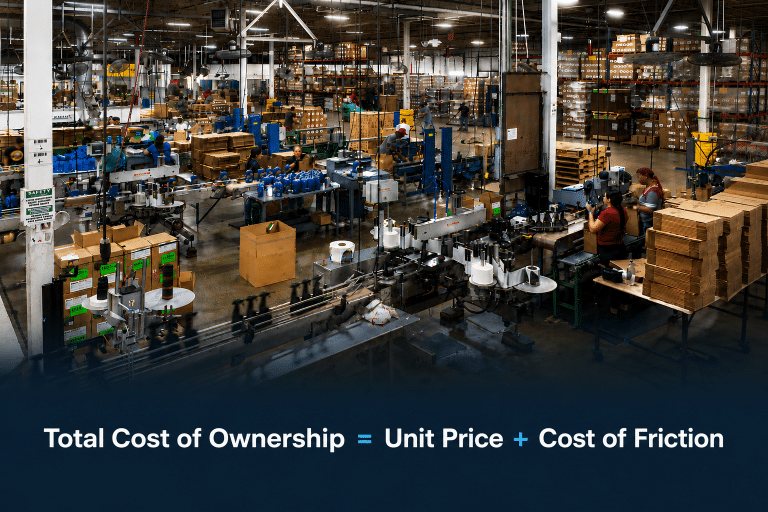
That’s where the real cost lives. Not in the unit price. In the friction.
Why Price Can Be the Least Predictive Thing to Compare
Two manufacturers can quote within pennies of each other and deliver completely different operational experiences. One runs clean: orders come in, product ships, documentation is accurate, and issues are surfaced early. The other requires constant follow-up. Timelines slip. Chargebacks arrive. Your team ends up managing the relationship more than running their business.
Neither of those realities shows up on a quote.
What the RFP captures is what the manufacturer is willing to say about their capabilities and what they’re willing to charge. It doesn’t capture the day-to-day reality of the relationship: the communication patterns, the process discipline, the accountability structures that determine whether a manufacturing partnership creates leverage or consumes it.
The Hidden Cost of Manufacturing Friction: Delays, Rework, and Internal Time
There’s a version of this that’s easy to quantify and a version that isn’t.
The quantifiable version includes expediting costs, rework, returns, and downstream penalties when a shipment misses a retail window. Retail compliance (chargebacks, OTIF enforcement, delivery window penalties) is its own discipline, and one worth examining separately. If your manufacturing partner’s operational gaps are showing up in your compliance portal, that’s a manufacturing problem before it’s a data problem. (See: Why Your EDI Chargebacks Are a Manufacturing Problem – Not a Software Problem.)
But the harder cost to see is internal time. How many hours per week does someone on your team spend chasing status updates, resolving discrepancies, and coordinating between systems? A higher acquisition cost from one supplier can lead to a lower total cost by eliminating downstream friction. Procurement teams know this in theory. Only some apply it when evaluating manufacturing partners.
The math is straightforward: a $0.08 difference in unit price across 50,000 units is $4,000. One expedited freight recovery can exceed that before the invoice arrives. One person spending five hours a week managing manufacturing issues represents tens of thousands in annual productivity.
The math isn’t complicated, but it sometimes doesn’t get done during the RFP process.
What a Strong Contract Manufacturing RFP Evaluates
The best RFPs don’t just ask for a price. They ask questions that surface execution quality, and will determine what the relationship will feel like to operate in six, twelve, and eighteen months in.
- What happens when something goes wrong mid-run: who communicates, to whom, and how quickly?
- What is your on-time delivery rate?
- How do you handle fill variances or packaging discrepancies?
- Can you show me your OTIF compliance rate across your customer base?
- What does onboarding look like, and how long before a new customer is running cleanly through your systems?
A partner who answers with specifics (actual numbers, actual process descriptions, actual examples) is a different kind of partner than one who answers with reassurances.
The Question That Predicts Whether a Partnership Actually Works
The right question isn’t just what does this cost? It’s what will this feel like to operate six months from now?
BPI operates with a 98% SLA/QA target and an average of 30 days from order to delivery. 100% of our clients have been with us for 2+ years. You won’t find these numbers on a quote, but they’re the numbers that matter most.
If you’re evaluating contract manufacturing partners and want to understand what execution quality looks like in practice, we’d like to be part of that conversation.
BPI Solutions helps brands bring products to life through formulation support, blend-and-fill operations, packaging, and distribution. Learn more at www.bpisolutions.com.
Sources:
FORGE Impact — Reduce Total Cost of Ownership with Contract Manufacturing https://forgeimpact.org/reduce-total-cost-of-ownership-with-contract-manufacturing/
Premier SS — How to Calculate Total Manufacturing Cost With CMs https://blog.premierss.com/contract-manufacturing/total-manufacturing-cost-contract-manufacturers/
Purchasing & Procurement Center — Total Cost of Ownership: 5 Key Components https://www.purchasing-procurement-center.com/total-cost-of-ownership.html
ISM — Understanding Total Cost of Ownership in Procurement https://www.ism.ws/supply-chain/ownership-in-procurement/