Pricing in chemical contract manufacturing isn’t arbitrary. It’s the result of real operational decisions that happen before production ever begins. Understanding what drives those decisions helps you ask better questions, plan more accurately, and find a partner who can deliver on what they quote.
In 2026, many brands across home care, automotive appearance, and industrial categories have been renegotiating supply chain relationships, mostly driven by reshoring activity, tariff stabilization, and pressure to tighten working capital. The result is more scrutiny on manufacturing costs, and more brands asking why two quotes for the same product can look so different. The answer usually comes down to the same five variables.
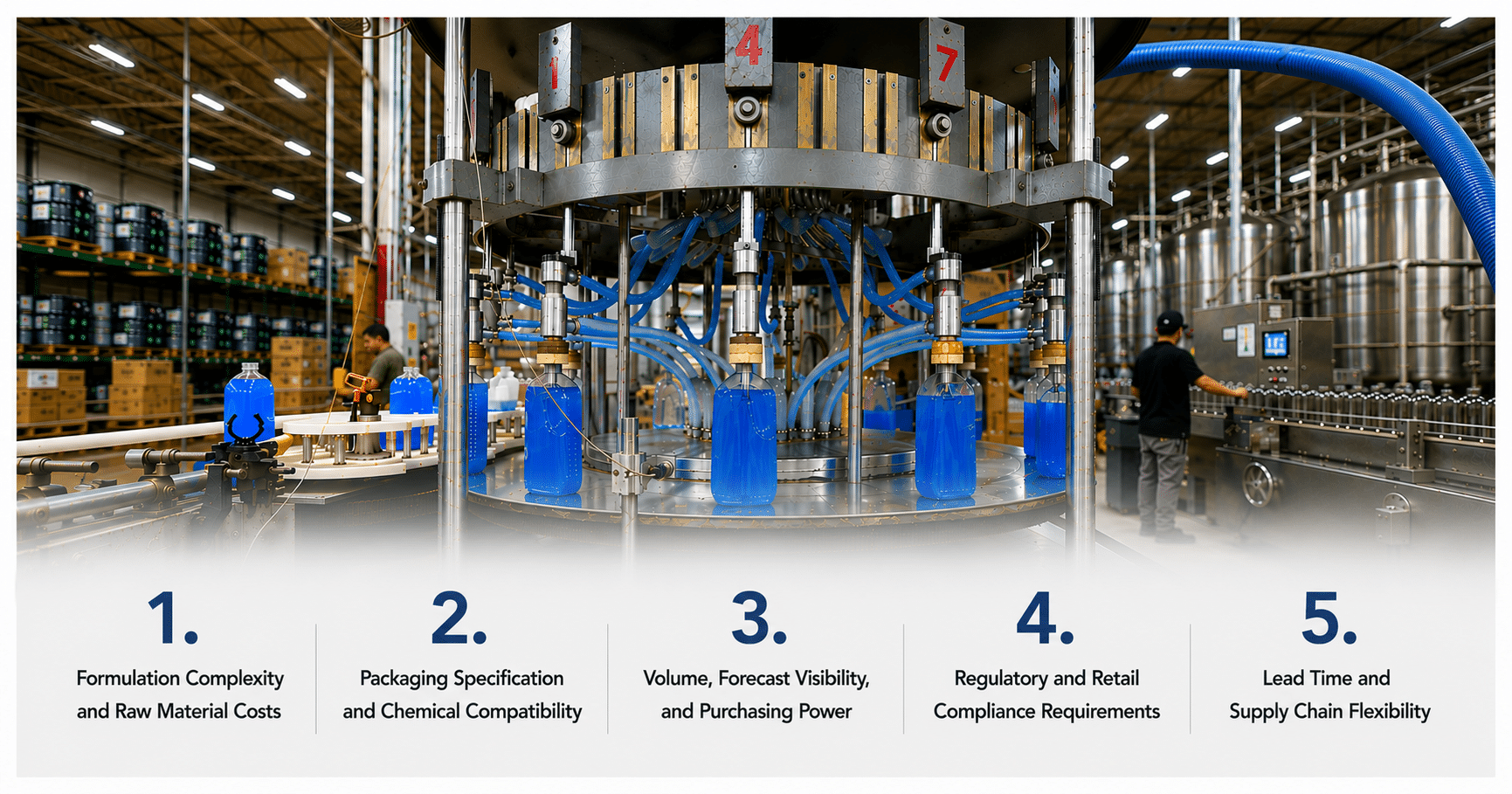
1. Formulation Complexity and Raw Material Costs
Your formulation is one of the biggest drivers of both cost and feasibility. The chemistry of your product — its reactive ingredients, handling requirements, and purity grades — shapes a significant portion of your quote before a single unit is produced.
Complex chemistries may require dedicated equipment lines, specialized environmental controls, or additional safety protocols. These costs aren’t padding but are real operational costs that surface when a manufacturer handles strong acids or bases, hazardous classifications, or materials outside their standard supply chain.
Raw materials are a primary cost driver independent of complexity. If your manufacturer already sources and runs the materials in your formulation, you benefit from purchasing efficiencies and system compatibility. If they don’t, they can often still produce your product, but expect that to show up in the quote.
A manufacturer with genuine formulation depth can often find efficiencies that a less experienced blend-and-fill operation simply can’t. That expertise has a direct effect on cost.
2. Packaging Specification and Chemical Compatibility
Packaging in chemical manufacturing isn’t just about brand presentation. Chemical compatibility between your formulation and your container material is a technical requirement that can significantly affect cost and sourcing time.
Hazard communication requirements, DOT shipping classifications, and retail compliance labeling all add steps that influence how your product can be packaged and delivered. Specialty closures, custom bottles, or non-standard case configurations affect both feasibility and minimum order quantities.
The more your packaging aligns with what your manufacturer already runs, such as standard components, familiar closures, configured lines, the faster and less expensive production becomes. Flexibility on specific components early in the process can unlock meaningful cost and timing improvements. A physical sample shared at the start of an evaluation accelerates this considerably
3. Volume, Forecast Visibility, and Purchasing Power
Volume drives cost in two ways: scale and predictability. Higher committed volumes unlock sourcing efficiencies, particularly for specialty inputs with limited supplier options and longer procurement lead times. But predictability matters just as much as the number itself.
When volume is unclear, manufacturers may price for risk. A brand that can provide a realistic range, even if it’s directional, gives their manufacturer room to structure a quote across tiers rather than defaulting to the worst case.
To illustrate the math: suppose a specialty raw material in your formulation carries a supplier minimum order of $5,000, regardless of how much you actually need for a given run. At 1,000 units, that fixed cost adds $5.00 per unit. At 2,500 units, a run that clears the supplier threshold and lets you right-size the order, that same $5,000 spreads to $2.00 per unit. That’s a $3.00 per-unit difference on a single input, on a single SKU, driven entirely by volume visibility. Across five SKUs running on similar economics, that’s a $15,000 annual swing in cost of goods before any changes to your formulation, your packaging, or your manufacturing process.
4. Regulatory and Retail Compliance Requirements
Chemical manufacturing carries regulatory obligations that go beyond standard quality requirements. EPA registration, VOC compliance, hazardous material handling, and retail-specific documentation all have direct cost implications, and they’re structural elements of the scope, not afterthoughts.
Retail compliance has become a meaningful cost variable. As enforcement has grown more automated, the distance between a manufacturing process gap and a financial penalty has gotten shorter. A manufacturer who treats QA/QC and EDI as connected disciplines, not separate functions, reduces that exposure before it reaches your P&L.
5. Lead Time and Supply Chain Flexibility
Chemical supply chains are often less elastic than other categories. Specialty inputs carry longer procurement lead times, limited supplier options, and minimum order constraints that don’t bend easily under urgency. Compressed timelines or unexpected demand surges frequently require expedited sourcing, and that urgency carries a cost premium.
Adequate lead time gives a manufacturer room to plan procurement and schedule production efficiently. That planning produces real savings: on materials, on scheduling, and on the downstream logistics that determine when your product reaches retail. For products with complex chemistry or specialty packaging, lead time isn’t just a cost lever. It can determine whether production is feasible within your window at all.
BPI’s average order-to-delivery cycle is 30 days, supported by a Memphis location that puts 70% of the U.S. within two delivery days. That combination reduces both cost and risk at the lead time stage.
What You Can Do Right Now to Improve Your Quote
The brands that get the most accurate quotes aren’t the ones with the simplest products. They’re the ones who show up prepared.
Share your SDS, TDS, formulation details, packaging specifications, volume expectations, and compliance requirements early. Be specific about what’s fixed and what’s flexible. A quote built on clear scope is one you can trust. One built on assumptions will require revisions, and by then, you’ve already lost time.
BPI Solutions helps build better brands with formulation support, blend-and-fill operations, packaging, and distribution. If you’re evaluating your manufacturing options, we’d like to be part of that conversation — get in touch.
BPI Solutions helps brands bring products to life through formulation support, blend-and-fill operations, packaging, and distribution. Learn more at www.bpisolutions.com.
Sources:
DBB/NWA — Plugging the Leak: Reclaiming Margin from Retail Deductions and Chargebacks https://www.dbbnwa.com/articles/plugging-the-leak-reclaiming-margin-from-retail-deductions-and-chargebacks/
Gray Group International — Supply Chain Resilience in 2026: How Smart Businesses Are Navigating the Tariff Storm https://www.graygroupintl.com/blog/supply-chain-resilience-2026-tariff-strategy/
Supply Chain Management Review — Six Months In: Are Tariffs Really Rebuilding American Manufacturing? https://www.scmr.com/article/tariffs-us-manufacturing-reshoring-impact-2025
Transimpact — New Tariffs, New Timeline: Preparing Your Supply Chain for the 150-Day Countdown https://transimpact.com/blog/new-tariffs-new-timeline-preparing-your-supply-chain-for-the-150-day-countdown
Woodridge Retail Group — Retail Compliance in 2026: New Rules, Less Grace https://www.woodridgeretailgroup.com/post/retail-compliance-1
Source Logistics — Retail Compliance Isn’t Getting Easier in 2026, It’s Getting More Fragmented https://blog.sourcelogistics.com/retail-compliance-isnt-getting-easier-in-2026-its-getting-more-fragmented