Many brands pressure-test their forecasts, budgets, and launch calendars every year. A contract manufacturer review belongs on that list, since your partner is the one who has to deliver them.
It’s planning season, and every number in your plan rests on an assumption that rarely gets written down: that your contract manufacturing partner will deliver it.
Most teams only revisit that assumption when something breaks: a launch slips, a retail window is missed, a chargeback arrives. By then, fixing a partnership is much harder than asking the right questions in October.
Why Planning Season Is the Right Time for a Contract Manufacturer Review
Right now you have almost a year of performance to look back on, you know what next year is asking for, and nothing is locked yet. The window is shorter than it looks: specialty materials and custom packaging take time to source, so a Q1 launch that isn’t on your partner’s radar today is already behind.
The bar is also rising. Retailers are investing in their own-brand production, which raises expectations for speed to market and cost to serve across the shelf (2). A partner who was fast enough this year may not be fast enough next year.
So before your numbers lock, take an honest look at how your partner performed this year and whether they’re ready for next year. These five areas cover what matters most: how they communicate, how reliably they deliver, how they solve problems, how they support growth, and what the partnership really costs you.
Five Areas to Review in Your Contract Manufacturer Before Your Plan Is Final
1. Communication: Are updates shared before anyone has to ask?
Strong partners keep you informed as a matter of routine, not only when something goes wrong. Think about a normal week this year. Did you get:
- Early notice when raw material or packaging lead times changed?
- Regular check-ins on your forecast and the capacity behind it?
- Structured reviews, like QBRs, with performance data you didn’t have to compile yourself?
If your team spent its time chasing status updates, that’s a communication gap, even in a year when nothing went wrong.
The same standard applies when something does go wrong. A raw material delay flagged early, with options attached, gives you room to adjust. If your team learned about most issues from a retailer or a missed delivery, that pattern will carry into next year.
Communication runs both ways. For new products in your plan, share scope early: formulation and technical data sheets, packaging specs or samples, directional volumes, and any regulatory or retail requirements. A vague scope leads to padded quotes and late surprises. Our Working with Your Manufacturing Partner guide includes the full checklist.
2. Reliability: Are orders delivered on time, in full, and to spec?
Look at the record, not the reassurance. On-time in-full (OTIF) delivery, fill accuracy, QA results, and order-to-delivery time should all be available on request. If your contract manufacturer can’t produce them, that’s a finding in itself.
Reliability also means documentation, labels, and ASNs that pass retail compliance the first time. Automated compliance systems cost suppliers an estimated 3% to 8% of annual retail sales in avoidable deductions (DBB), and those gaps start on the production floor. (See: Why Your EDI Chargebacks Are a Manufacturing Problem – Not a Software Problem.)
For many brands, reliability is mostly about replenishment. Household cleaners, automotive appearance products, and pet grooming products are bought again and again, and online subscriptions make that demand steadier and less forgiving of stockouts. Seasonal peaks, like winter washer fluid or spring cleaning, test whether your partner can hold capacity when you need it most.
3. Problem resolution: Are issues solved at the source?
Hearing about a problem early is communication. Making sure it doesn’t happen again is problem resolution. When a batch came in off spec or a component ran short, who owned the fix? Did your partner find the root cause, explain what changed, and confirm it worked, or did the same issue come back a few months later?
A partner who solves problems at the source makes next year easier. One who patches symptoms makes it a repeat.
4. Growth support: Is the partner ready for what next year will bring?
Next year’s plan likely asks for more than this year’s did. Check whether your partner can deliver the new parts:
- Product innovation: Can they help develop new products or reformulations?
- Clean-label and natural formulas: Natural and plant-based products are growing faster than conventional formulas in household cleaning, and pet grooming is moving toward hypoallergenic, sulfate-free, and pH-balanced formulations. Can your partner match the performance of your current formula while making the switch?
- Formula and packaging changes: Can they adapt formulas and labeling when state rules, new markets, or retailer requirements change? Can they update packaging for new requirements?
- New retailers and channels: Can they meet new compliance, distribution, and EDI requirements?
- Different volumes: Can they run small test batches, ramp up, or handle a surge on short notice?
If those pieces depend on three separate vendors, you’re managing the handoffs between them. A liquid contract manufacturer with formulation, blend and fill, packaging, and distribution under one roof turns them into one conversation. That matters in home care, automotive appearance, pet grooming, and industrial products, where formulation complexity and retail compliance intersect, and where distribution reach shapes repeat sales as much as production does.
5. Hidden costs: How much internal time goes into managing the partner?
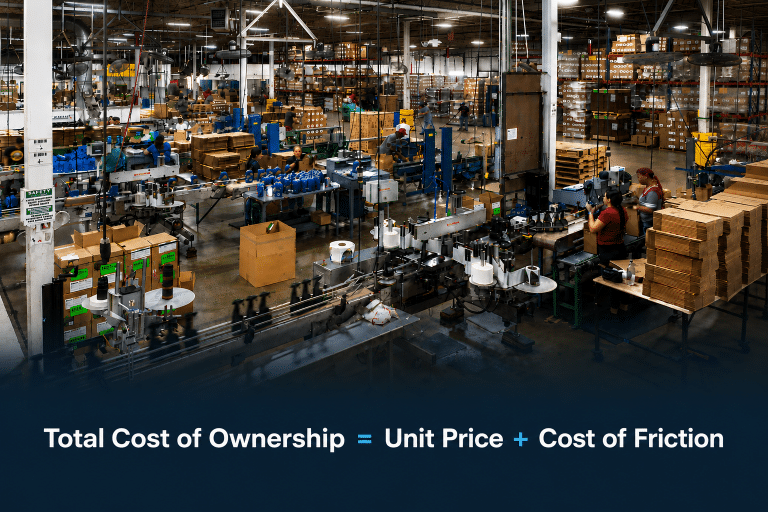
Add up what this year cost you beyond the invoice: expedited freight, rework, chargebacks, and the hours your team spent chasing updates. One person spending five hours a week on manufacturing issues is about 250 hours a year, or nearly $19,000 at a $75 loaded hourly rate. That’s money next year’s plan probably assumes will go toward growth.
Questions to Ask Your Contract Manufacturer Before Your Plan Locks
Bring this year’s performance data, next year’s forecast (even a directional range), your launch calendar, and requirements from any new retail accounts. Then ask:
- Where did we fall short this year, and what caused it?
- What was your on-time, in-full rate on our orders this year?
- What does next year’s forecast mean for your capacity, sourcing, and lead times?
- Can you hold capacity for our seasonal peaks, and how early do you need our forecast to secure materials?
- What regulatory or retailer changes do you see coming next year that could affect our formulas or packaging?
- What do you need from us, and by when, to support our launches?
- If we add a new retail account or channel, what changes on your side?
A partner invested in your success will answer with specifics: actual numbers, process descriptions, and examples. Vague answers mean vague accountability.
If you’re working through next year’s plan, we’d be glad to be part of that conversation. Let’s talk.
BPI Solutions helps build better brands with formulation support, blend-and-fill operations, packaging, and distribution. Learn more at www.bpisolutions.com.
Frequently Asked Questions
How often should you review your contract manufacturer?
At least once a year, ideally during planning season before budgets lock, with quarterly business reviews (QBRs) in between. An annual review gives you a full year of data and still leaves time to adjust capacity, sourcing, and launch timelines.
What KPIs should you track for a contract manufacturer?
Track on-time in-full (OTIF) delivery, fill accuracy, QA results, order-to-delivery time, and chargebacks. Add internal costs like expedited freight, rework, and team hours spent managing issues to see the partnership’s true cost.
Does a supplier performance review mean switching manufacturers?
No. Most reviews are one structured conversation about what worked, what didn’t, and what next year requires. Strong partners welcome it because it helps them plan capacity and materials.
Sources
DBB — Plugging the Leak: Reclaiming Margin from Retail Deductions and Chargebacks
Mordor Intelligence — Household Cleaners Market Size & Share Analysis (2026–2031), updated September 2026
Future Market Insights — Automotive Appearance Chemical Market (2026–2036), August 2026
The Insight Partners — Pet Grooming Products Market (2026–2034), February 2026